
Ebook – Professional Watch
Escaping the “Infobesity” Trap
In the modern training landscape, we are often drowning in a sea of bookmarked links, unread newsletters, and endless browser tabs. This state of “infobesity”—the paralysis caused by information overload—creates a dangerous paradox: the more data we accumulate, the more we feel disconnected from the fast-moving reality of the field. Many trainers fall into the “Snail Watch” trap: a passive, solitary, and ultimately fruitless hoarding of links “just in case.”
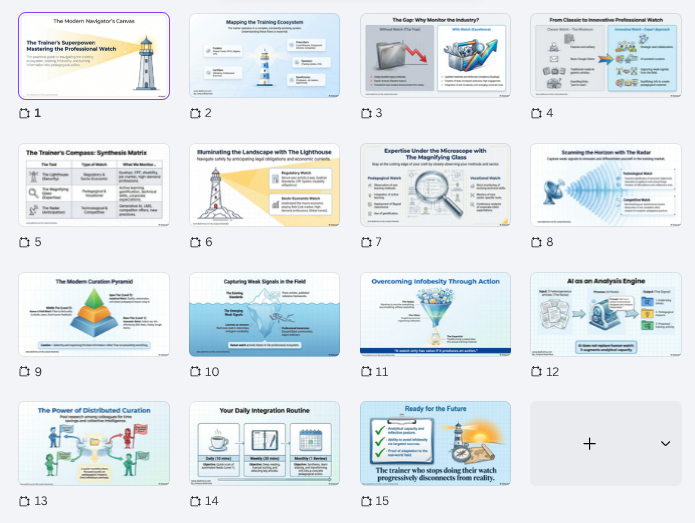
For those pursuing professional excellence, particularly within the TPFPA (Professional Trainer) framework, a “Professional Watch” (Veille) is not a mere administrative chore or a box to check for Qualiopi compliance. It is a strategic superpower. To move from a passive observer to a “Modern Navigator,” your watch must meet the O.R.E. criteria: it must be Organized, Regular, and Exploitable (and strictly Centered on your needs). Without these, you aren’t a professional; you’re just a digital hoarder.
A Watch Only Has Value if it Produces Action
The most common mistake in professional development is equating accumulation with intelligence. Pedagogical stagnation occurs when we prioritize the collection of information over its transformation. To adopt an expert approach, you must pivot: the goal of information gathering is not storage, but pedagogical action.
Whether it is updating a training module for reinforced compliance, testing a new digital tool, or integrating real-world vocabulary into a case study, the data must be exploited to create value.
“A watch only has value if it produces an action.”
If your research doesn’t change the reality of your training room or increase the autonomy and engagement of your learners, it is merely digital clutter.
Your Learners are Your Best Secret Sensors
While traditional monitoring focuses on the “Tip of the Iceberg”—official laws, press articles, and reference frameworks—the most innovative trainers dive deeper into Professional Immersion. Real value often lies in the submerged “Weak Signals” found in Discord communities, specialized Slack channels, and expert webinars.
The Iceberg Model: Learners as Sensors Your students and apprentices are your primary eyes and ears on the shop floor. An expert watch includes an active “Human Watch” component where you treat learners as sensors who bring back:
- Real-world vocabulary currently used in the industry.
- Actual software usage and emerging corporate tools (not just what’s in the manual).
- Field difficulties and internship obstacles that signal a need for new training modules.
By actively listening to these signals, you ensure your content is connected to the real-world ecosystem rather than generic theory.
The Three Levels of the Curation Pyramid
To transition from the “Classic” minimum to a “Rocket” expert approach, you must organize your curation through a three-tier hierarchy:
- Level 1: Automatic Watch (The Base): Let technology do the heavy lifting. Use tools like RSS feeds (Feedly) and Google Alerts to collect raw information effortlessly.
- Level 2: Human & Field Watch (The Middle): Filter raw data through the lens of reality. Engage with peers, participate in professional communities, and analyze direct learner feedback to qualify what matters.
- Level 3: Analytical Watch (The Apex): This is the strategic layer. Here, you use AI and personal synthesis to contextualize information and extract its specific pedagogical impact.
Navigating the Ecosystem with the Three-Tool Compass
A strategic navigator understands the training ecosystem’s complex flows. You aren’t just watching “news”; you are monitoring specific actors: Funders (OPCO, CPF, France Travail), Certifiers (Ministries, Professional Branches), Prescribers, and Beneficiaries. Use this Synthesis Matrix to map your efforts:
- THE LIGHTHOUSE (Security): Illuminates the structural environment. Focus on Regulatory watch (Qualiopi, CPF, disability laws) and Socio-Economic watch (job market trends, métiers en tension). This ensures your activity remains compliant and aligned with the demands of Funders and Certifiers.
- THE MAGNIFYING GLASS (Expertise): Provides a deep dive into your craft. Focus on Pedagogical watch (active learning, gamification) and Vocational watch (technical skills, corporate expectations) to keep your expertise at the cutting edge.
- THE RADAR (Anticipation): Scans the horizon for external signals. It covers Technological watch (Generative AI, LMS platforms) and Competitive watch (competitor offers, new market practices) to help you innovate before your competitors do.
AI as an Analysis Engine, Not a Replacement
In the expert approach, AI is the “Analysis Engine” that turns “Noise” into “Signals.” Instead of losing hours to 50-page reports, you feed heterogeneous data into an AI to augment your analytical capacity.
The game-changer for TPFPA candidates is the Expert Prompt. Do not ask the AI for a summary; ask it to adopt a persona:
“Act as a senior instructional designer and analyze these texts. Identify the underlying trends, the direct pedagogical impacts, and propose three concrete training activities based on this data.”
This process ensures you aren’t replaced by AI; you are augmented by it, allowing you to synthesize vast amounts of “Noise” into actionable training material.
Beat Overload Through Distributed Curation
Professionalism is defined by the quality of your integration loop. To avoid individual burnout, adopt Collective Intelligence via a Distributed Watch model. In an organization, different colleagues take the lead on specific flags:
- Referent A: AI & Technology.
- Referent B: Regulatory & Qualiopi.
- Referent C: Vocational Evolution.
Meet monthly to share only the pedagogical impacts. Individually, protect your time with the 10-30-1 Routine:
- 10 Minutes Daily: A quick scan of Level 1 automated feeds.
- 30 Minutes Weekly: Deep reading, manual sorting, and selecting key articles.
- 1 Monthly Review: A dedicated session to transform your findings into one concrete pedagogical action.
Proving Your Reflexive Posture
If you are a TPFPA candidate, the jury is looking for more than a list of websites. They are evaluating your Analytical Capacity and Reflexive Posture. When they hit you with the “Crash Test” question: “How do you avoid infobesity?”, do not give a vague answer.
The Winning Strategy: Explain your O.R.E. methodology. Detail how you target your sources, show how you automate the collection to save mental bandwidth, and provide a concrete example of how a “Weak Signal” from a learner led to a specific update in your training support. This demonstrates Professionalization—the ability to adapt to the real-world field in real-time.
The Reality Connection
The shift from a passive observer to a “Modern Navigator” is what distinguishes an average trainer from a strategic leader. Monitoring the industry is not about the quantity of links saved; it is about the quality of the connection to the field.
As you audit your own routine, remember the ultimate professional warning: “The trainer who stops doing their watch progressively disconnects from reality.” Is your current routine producing actual change, or are you just organizing the dust on your digital bookshelf?